Tuesday, July 14, 2020

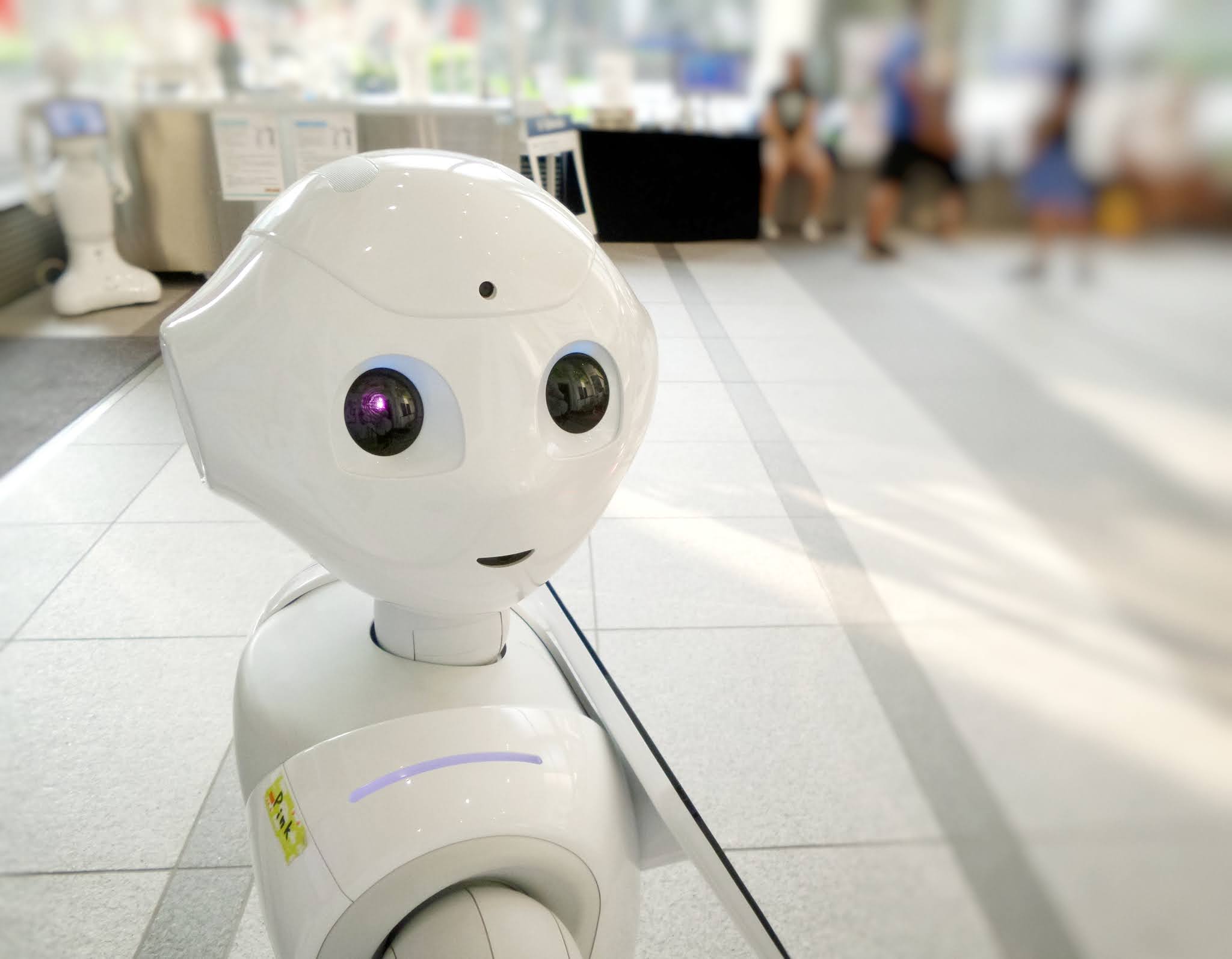
What is a Robot?

SMART SUBU


What is a Robot


What is a robot?


Let's define the term: Robot. It means slave labourer, with its root in the Czech word “robota”. They are just like a servant. If we are going to give some tasks to the robot,  it is going to perform those tasks just like a servant.


Who coined the Term?


The term was introduced in the year 1921 by Karel Capek a Czech playwright. In a particular drama, he introduced a term: robota, that is, the robot. But, the way he described a robot is as follows: the robot was look-wise similar to a human being.

But, nowadays we use a few robots, which do not look like a human being. So, this is the way actually, the term robot was introduced in the year 1921. But, during that time, there was not even a single robot in the world. The robot is an automatically controlled machine. And, it is reprogrammable that means the same robot can be made to do a variety of task. 

With the incredible advancement in the field of robotics, amazing developments are awaiting future.
Watch the video and enjoy.


What is the difference between a Shallow copy and deep copy?

SMART SUBU


What is the difference between a Shallow copy and deep copy


In Python, if we want to go for faster execution of the program, depending on the size of the data, a shallow copy is preferred, where it is used as a reference pointer which copies the values by referring to the original objects and changes are made in any of the members of the class but the original copy is not affected by it.


Whereas, the deep copy concept in Python is used to store the values that are already copied. The reference pointers are not copied into the objects in case of deep copy, but it makes the reference to an object and the new object that is pointed by some other objects are stored.


Changes made in the original copy will not affect the other copy that is used in the object. With the application of deep copy concept, the execution of the program become slower, because of multiple copies of the same object that needs to be called for execution of the program again and again.


So, in nutshell, we can say that shallow copy helps in faster execution of the program without disturbing the original copy, whereas deep copy makes multiple copies of reference of references into new memory locations of the same instance and thus results in in slow execution of the program.

What is machine learning to a kid?

SMART SUBU


What is machine learning to a kid


As a kid, you must be excited to know about machine learning, as the name suggests it is a process of teaching machines to help them learn new things with the help of certain rules or by its own, exactly the way we humans learn new things.

The Definition

Let us first understand that machine learning is a process by which includes two things, the first part is a machine and the other part is learning. Now, we must focus on the word learning which is a process of identifying and classifying objects based on certain features and characteristics. 

How it works

We can teach machine certain rules and systems of classification. Based on the rules, the machine learns to identify and classify objects based on certain characteristics which it has learned. 

How the machines are trained

Training of the machines is done with the help of suitable examples over a period of time. This particular process of training the machine in order to clearly identify and act according to the requirement of the user can be defined as machine learning. For example, if you want your computer to identify your friends by name what you need to do is that at first, you need to train your computer with the pictures of your friend and the characteristics of each of your friend along with their name. 

 Why we need more examples

 The computer will learn with the examples that you have set, and then next time a friend comes to your home, the computer can identify and classify your friend and successfully name them. As more examples are fed into the system, more accurate classification and identification of your friends become easier for your computer. This particular process of helping the computer learn is defined as machine learning.

 The Next Step

 Now, you may be curious to know about the different types of machine learning which we will discuss subsequently. If you are interested to know more about machine learning, you can mail at smartsubu2020@gmail.com.


What is the difference between KNN and K means clustering?

SMART SUBU


What is the difference between KNN and K means clustering

We are already aware of supervised and unsupervised machine learning algorithm as discussed in our previous sections. Let us understand K means clustering first. It is an unsupervised machine learning algorithm used for clustering where the algorithm is trained to divide the whole data set into different clusters as decided by the user. K is the number of predefined clusters.

The number of clusters that the algorithm is supposed to form is defined by the k-means clustering.

Whereas, KNN is K Nearest Neighbour algorithm, it is a supervised learning technique used for regression or classification. The algorithm is trained to identify any random unit and after that, the algorithm tries to locate the nearest neighbours based on the association of characteristics.

The number ‘K’ represents the number of nearest neighbours that the particular algorithm is supposed to find.

If You are Interested to know more about Machine Learning Algorithms, You can mail to smartsubu2020@gmail.com.

What is Artificial Intelligence?

SMART SUBU
What is Artificial Intelligence

Over a period of time, Artificial Intelligence has influenced life and industry equally. It has acted as the main driver of emerging technologies, like the Internet of Things (IoT), Robotics, Big Data and continues to act as a technological innovator to rule the future.

Machine learning along with computer vision and deep learning algorithms have made a big stride in the technological empowerment, wherein, the future looks completely dominated by this technological advancement.

With simple devices like smartphone, it is possible to incorporate the power of technological advancement and the artificial algorithm coupled with machine learning capacities miracles can happen overnight.

Today, the software as well as technological advancement has made it possible to virtually make any device at home with available resources without much sophistication. It is also possible to design systems which can start to learn from each other and in the process of learning evolve and be better and better.

What is very pertinent in this time period is the requirement of incorporating the learning and technical skills in the mindset of the people so as to become future-ready.

 In the ecosystem of artificial intelligence it is possible to design systems and procedures where in each of the stakeholders on board will be able to learn and help each other in a symbiotic way and develop the whole ecosystem.

If you are interested to know more about Artificial Intelligence, you can mail at smartsubu2020@gmail.com.


What is Internet of Things (IoT)?

SMART SUBU


What is Internet of Things (IoT)


In simple terms, the Internet of Things can be defined as a collection of interconnected objects, equipment, workplaces or business. We need to understand first, why we need IoT? It is because IoT can provide an advanced level of services, it can be made responsive and can be tailor-made for building smart cities, smart homes and smart agriculture.

Technically IoT are embedded systems with basic computing system (with embedded processors and systems).

The IoT operates with the unification of technologies like low power embedded systems, big data, machine learning, cloud computing and networking.

Two approaches are used, one is based on expanding the existing network and the other by building a new network from scratch.

Different types of technologies like RFID, Nano Technology, Sensor & Actuators and smart networks or communication paradigms are used for the functioning of IoT.

IoT devices for proper functioning should have the following characteristics

  • ·        
  • ·        
  • ·         An abundance
  • ·        

In a nutshell IoT consist of Sensors along with smart systems having an application layer acting as a user interface.

The building block of IoT consist of Sensors ( senses signal from the environment), Network ( the sensed information is passed through the network ) and Actuators ( which perform an action based on the input received from the sensors).

Enjoy the video on Managed Services - Supply chain transformation with IOT and Blockchain.


Logistic Regression

SMART SUBU


Logistic Regression


It is important to understand the different machine learning algorithms. Keeping abreast with the understanding of the algorithm can help the data science enthusiast understand their problem, their data set and the application procedure to derive the intended results.

We will start our discussion with Logistic Regression

Logistic regression is one of the popular mathematical modelling procedure which is used in many of the data analysis algorithms. It is basically a regression analysis where the value of the outcome variable (dependent variable) is restricted between 0 and 1. In order to achieve this, a logistic function is used which is the mathematical function on which the logistic model is based. The beauty of the logistic model is that the desired output value can be easily truncated within the comprehendible range of 0 and 1 irrespective of the range of output value.

If you are interested in how to apply logistic regression and the mathematical intuition behind it, you can express your interest in joining the data science boot camp for free by email to

Monday, July 13, 2020

What is a Manipulator?

SMART SUBU


What is a Manipulator

By manipulator, we mean that it is a robot with a fixed base. This manipulator could be either serial manipulator or parallel manipulator.

As we change the program of a robot, it can be made to do multiple tasks. And, it is multifunctional, that means, the same robot, the same manipulator can perform the different types of machining operations. It can do some sort of peak and place type of operation, and so on. Now, here actually, we are using the term: manipulator.

In CNC machine-like Computerized Numerical Control Machine, we can perform a variety of tasks by changing the program.

Similarly, in robots, the same robot can be used to serve a variety of purposes, simply by changing the program. But, here, there is a basic difference between the level of re-programmability, which can be achieved by a robot, and that can be achieved by a CNC machine.

It is important to note, that the level of re-programmability, which can be achieved by a robot is more compared to that of the CNC machine. And, that is why a CNC machine is not a robot. 

If You are Interested in Robotics, You can get mail at smartsubu2020@gmail.com.

What is the process of deployment of models?

SMART SUBU


What is the process of deployment of models

In simple terms, deployment of any machine learning model should start from identifying the application that we want to build.

Second, we should understand the data requirements for the model and then gather the data. After that, we need to identify our model and train the model with the data and test for accuracy of prediction of the model.

After that, we need to create a new web application using the appropriate framework, for example, the most common Python-based web application framework is Flask. Then, we need to complete the code or rather put the code in some repository like GitHub.

We need to create an account in any of the service providers specialized in providing a platform as a service and the common being Heroku. After that, we need to link the account that we have created in Heroku with that of the GitHub.

Heroku is a free platform which can be used to you create the API for the machine learning model that we have created. We need to understand that there are requirements of the certain libraries for running the code in the Heroku platform and environment.

What are the different types of machine learning?

SMART SUBU


What are the different types of machine learning

We hope you have understood about machine learning and if you have not gone through the post on machine learning, kindly  

As the name goes supervised learning is just like the learning process used in schools, where there are a set of instructions given by our teacher and we are asked to perform a certain specified task. But, in case of machine learning the training data set is provided to the computers, and the user acts as a teacher where the algorithms are designed  to give a very specific output (just as the students).

The machines are trained on the predefined data set before it can be used to make any decisions based on new data. For example, the machines are set to identify certain objects based on very specific characteristics which are very unique to that particular object.

Suppose a machine is trained on identifying whether a particular creature is a dog or cat. Specific features of dog and cat are fed to the computer during the training process and levelling of the pictures are done so that whenever new characteristics or features are fed into the computer it is able to correctly identify those features and come up with the outcome of whether it is a dog or cat.

The second type of learning is unsupervised learning where the machines are given a particular data set and left to learn on its own. To simplify, the machine is fed with data and the algorithms by itself tries to find pattern and features in the data set and put them into different categories by identifying patterns and correlation within the units of the data set.

It can be mostly said as a self-study process, where the machine learning algorithm is put into its own to identify and act by identifying relationship among the features of the different clusters. Clustering is one of the most commonly used unsupervised machine-learning techniques.

The Third category of machine learning is reinforcement learning, where the machines are left to learn by itself, but, here the algorithms of learning are rewarded or penalized based on the actions that they perform. For example as a child if you do good things you are rewarded, and hence, you are encouraged to perform that action again and again, whereas if you are given punishment for a particular act of yours you tend to not repeat it.

Similarly in reinforcement learning the algorithm is rewarded when it performs the correct task and thus the algorithm learns and tries to repeat the same task again and again. Whereas if penalized for a task it tries not to repeat those task.

In this reinforcement learning process, the machine learns by the trial and error method. In terms of machine learning that rewards and penalties are decided based on the predefined actions which the machine needs to perform in interaction with its environment.

If you are interested to know more about machine learning, you can mail at smartsubu2020@gmail.com.

What are List and Tuples in Python?

SMART SUBU


What are List and Tuples in Python

In Python, List and Tuples both are data structures. In case of List, we can include integers, as well as characters, in the data structure and the values in the List, can be edited or altered, in technical terms, it is known as mutability.

Whereas in the case of Tuples, characters and integers are included, but those cannot be edited, hence only they are immutable. But, the question which comes in mind is that if List and Tuples have the same characteristics of data structure, why we need two types of data structure.

Why we need two types of data structure

When there is a requirement of a fixed data structure which cannot be altered throughout the scripting of the program we can safely use Tuple. But, if we need a dynamic data structure which can be altered and edited as required during the scripting process of the programming, List is more preferable.

 So in order to meet the requirement of the programming and to make the scripting efficient, either List or Tuples are used. Tuples are preferred in a memory-intensive task, whereas, List is preferred in case of buffers. When we are sure about the number of columns in a data structure we should select Tuple and when we are not we should go for List.

If you are interested in Computer Programming, You can mail at smartsubu2020@gmail.com.

Impact of Artificial Intelligence

SMART SUBU
Impact of Artificial Intelligence


Future is now and the impact of AI is virtually everywhere. No major industry can survive without employing modern AI, or more specifically in technical terms without employing “Narrow AI”.

The application of machine learning models and deep learning algorithm using the data trained models with the objective of performance specified function falls under the purview of Narrow AI.

With the advent of robust IoT connectivity along with the proliferation of connected devices and ever-increasing computer processing power, data collection and analysis has become easier for machine-learning algorithms to operate and evolve.

Some of the organizations and business processes have already incorporated AI into their DNA, for example, TESLA, whereas others are gradually moving into the sphere of AI acceptance. However, it is undeniable that the impact of artificial intelligence is going to be very big in the coming days and cannot be ignored.

The major areas where AI has made an impact

Transportation: it will take another 10 years or more to affect the autonomous transportation process, however, it will become a reality that the autonomous cars will be seen on roads more frequently than the manually driven one.

In the manufacturing sector, AI-powered robots are seen to be working along with the humans in a limited range and capacity in the assembly and stalking lines. Predictive analytics and sensors are frequently used in the manufacturing units to keep the equipment running smoothly.

In the healthcare sector, AI has found its application in disease recognition and diagnosis. Speed up in the drug discovery and trial process in creating virtual nursing assistants, monitoring patient is possible due to the application of AI.

The application of Big Data Analytics is to create more personalization inpatient experience and service delivery.

The education sector is also impacted by the progress of AI with the digitization of textbooks. Early-stage virtual tutors and analysis of the emotions of students with the help of facial recognition and analysis software to tailor the delivery of classes according to the individual needs.

These are only the starting points of AI. 

With the ever-increasing advancement in the algorithm capacity, machine learning can handle intelligent software and the capability of AI is bound to increase leap and bound over the period of time and can deliver unimaginable results which we as humans are not even capable of comprehending as of now.

Major Tech Giants like Apple, Google, Amazon and Microsoft is spending billions of dollars in developing product and services in the Artificial Intelligence domain along with universities making specific related courses, Research and Development to explore the capability of artificial intelligence to deliver big results in the near future.

Sensors

SMART SUBU


Sensors


Let us try to understand what are the essential building blocks of the internet of things. One of the very essential components of the internet of things is sensors and the other one is actuators. The sensors basically sense the physical phenomena that are occurring around them.

Actuators actuate (take some actions) that means they perform some actions on the physical environment based on the sensed information by the sensors.

Sensors are of different types depending on the parameters they are going to sense. The sensor performs based on the temperature, pressure, humidity conditions and lighting conditions.

The sensed information is sent over a connected system network. The sensed information is transmitted based on what has been sensed and some physical activity is performed by an actuator based on the information sent by the sensors.

When we talk about sensing, we need to understand what is sensing. A sensor detects or senses the changes in the ambient conditions or it can also sense the state of another device, so maybe one sensor can sense the state of change in another device.

Sensing is done with the help of identifying some physical property of the ambient conditions of the environment in which the sensor is in or of another machine or a system that can be sensed with the help of sensors.

If you are interested to know more about Sensors, You can mail to smartsubu2020@gmail.com.

K Nearest Neighbours

SMART SUBU
K Nearest Neighbours


It is important to understand the different machine learning algorithm. We have already discussed Logistic regression (if you want to know about logistic regression, please

We will discuss K Nearest Neighbours

In the arena of classification algorithm, K Nearest Neighbours or KNN as known popularly is one of the most used algorithm.  The algorithm uses classification function to classify objects at the local level deferring all the calculations until complete classification is achieved, hence, this algorithm is also known as the lazy learning algorithm.

The algorithm works by selecting the k nearest neighbours from the training samples based on proximity probability and the distance measure for the test sample and then the algorithm predicts the test sample with the major class amongst k ( as specified by the user) nearest training samples.

If you are interested in how to apply K Nearest Neighbours classification algorithm and the mathematical intuition behind it, you can express your interest in joining the data science boot camp for free by email to


Sunday, July 12, 2020

What is Robotics?

SMART SUBU
What is Robotics


The term: robotics was coined by Isaac Asimov in the year 1942. Isaac Asimov wrote one story, the name of the story was Runaround. And in that particular story, he used the term robotics during 1942, there was not even a single robot in this world.

In robotics, we use the fundamentals of different subjects, for example, physics, mathematics, mechanical engineering, electrical and electronics engineering, computer science. And, that is why it is a bit difficult to become true robotics.

We will have to know the fundamentals of all these basic subjects and robotics is actually a multi-disciplinary subject.

If you are interested more about Robotics, You can mail to smartsubu2020@gmail.com.

What is GIL in python?

SMART SUBU
Impact of Artificial Intelligence


There are two concepts in python, one is threading and the other one is the processor. In order to speed up the execution of the code in python, multi-threading package is used in python. Global Interpreter Lock (GIL) is a construct in python which ensures that only one thread is executed at a time while running the code.

The mode of operation of GIL is that a particular thread acquires the GIL, execution is done and then the GIL is passed into the next thread.

It may seem that the threads are executed in parallel, but, actually, each of the threads are executed singly and thus GIL adds to the overhead while execution of a particular programme.

It is a process of multi-threading using the CPU core by taking individual threads at a time. GIL should be used based on the context of the programming and the number of core processor present on the computer.

If You are interested in Computer Programming, You can mail to smartsubu2020@gmail.com.


What is deep learning?

SMART SUBU
What is deep learning

In its very simplistic term, deep learning is the subset of artificial Intelligence design paradigm which is based on the philosophy to mimic the human way of learning. 

Why it is called Deep Learning is mainly contributed to the usage of the term by Geoffrey Hinton (Deep). But, another philosophical interpretation may be that it helps the machine to go deep into the learning dimensions and not stay at a superficial level.

The neurons based on the extent of trigger fires and send signals for appropriate decisions. 

In the same way machines generate experiential learning with the help of neural networks designed to facilitate the process of learning. 

This leads to the question, what is the neural network and how does it work. We will discuss that in Neural Networks.

What is the difference between machine learning and deep learning?

SMART SUBU


What is the difference between machine learning and deep learning

Machine learning and deep learning are more or less on the same genre of machine learning algorithms but with a slight difference in the way they are being executed.

In the case of machine learning, what we do is that first of all we try to identify the defining features from the data set which correctly defines or classifies the data and this process are known as feature extraction. 

What we do next is that we feed these features into our classification algorithms to train the machines in order to identify and predict the correct output.

Deep learning is a subset of machine learning where the feature extraction and classification is done simultaneously by the algorithm itself with the help of neural networks set for the particular purpose in the algorithm. 

Deep learning is more influenced by the working of the human brains where the inputs are fed and the processing is done in the hidden neural layers and finally, the outputs are produced. 

Deep learning algorithms have become more popular in case of image recognition, computer vision and natural language processing.

Artificial Neural Networks, Recurrent Neural Network and Convolution Neural Network have played a significant role in deep learning. Don’t worry if you don't know anything about these neural networks we will discuss this particular ANN, CNN and RNN separately.

ACTUATORS

SMART SUBU
ACTUATORS


Actuators basically perform certain physical actions based on the readings of the different types of sensors. 

Actuators are based on the working principles of electronics, electrical or mechanical systems with some kind of control signals.

These control systems act on the environment so an actuator requires some kind of a control signal and a source of energy for their functioning.

There are different actuators that are available for use in IoT (Internet of Things).

Control signals are required for the actuators, when these actuators receive a control signal they respond by converting that energy into mechanical motion. There are different kinds of actuators for e.g. hydraulic actuator, pneumatic actuator etc.

The actuators give an output based on which there can be some linear motion or some oscillatory motion or rotatory motion.

There are different kind of soft actuators which are actually polymer-based and are designed to handle fragile objects like fruit harvesting in agriculture or in biomedicine handling the internal organs of human beings.

Soft actuators are typically used in robotics and are quite popular. They use SMPS, which are Shape Memory Polymers and the behaviour of the polymers depend on the change of the stimuli of the environment.


How AI is going to impact work force and job and its solution

SMART SUBU


How AI is going to impact work force and job and its solution

Like all other technology, AI is also expected to have a greater impact on the workforce and the job scenario in the future. It is apprehended that most of the jobs are going to be replaced with machines. However, this apprehension needs to be justified with the fact that the jobs which are routine in nature are likely to be replaced with AI-first.

The bottom 50% of the world in terms of income or education is going to be badly hurt with job displacement. More repetitive the task and more quantitative the nature of this repetition, AI is expected to replace this kind of scripted task very quickly in the coming 5 to 10 years.

The task requiring creative skills and out of the box thinking requiring innovative interventions is likely to remain and it is expected to fetch a higher dividend in the future. Mechanization in terms of artificial intelligence has already begun and it cannot be stopped as of now, just like the wave of the Internet and other technological advancements which have become a part of modern life.

But what is the way out of this displacement in the workforce? The machines will lack in creativity and have no compassion for love. So it is important that human qualities can be harnessed and made available in the coming future rather than specializing in a repetitive task for routine works.

It is pertinent that new skills like the language of coding are incorporated in all spheres of life and people are made literate in the language of coding. Huge investment in the areas of education to teach the prerequisites of AI to people and retrain them for the new jobs will be beneficial.

People need to have a basic understanding of programming and they should be capable enough to learn the new language and it is important to learn the new language as quickly as possible because in future if somebody is coding illiterate and does not know to the program they are going to face great difficulty in finding any petty jobs.

The fast people are able to understand what the technology is capable of doing and they understand their domain very well they can start to make connections and identify what is the problem paradigm and find suitable solutions to it with the help of AI Technology.

If you are interested in Coding and Computer Programming, You can mail at smartsubu@gmail.com.